
PROJECTS
Partnership Projects
The following projects were completed as part of my graduate studies in public history and historic preservation. Each project was a collaborative effort, with responsibilities assigned according to individual interest and expertise. My contributions focused on architectural analysis, identifying architectural styles, assessing building conditions, and developing maintenance and preservation recommendations. Full reports can be found here: Partnership Projects
Service Learning
As both an undergraduate and graduate student, I participated in two nine-day summer field courses focused on earthen architecture and preservation on the Great Plains. During the first course, I was introduced to the practical application of historic preservation through hands-on work at the Hutmacher Farm. In the second course, I led a small team of students and volunteers through various stages of the preservation process. These experiences provided valuable training in preservation methods while demonstrating the importance of collaboration, stewardship, and public engagement in protecting historic resources.
T. S. Stribling House
The Stribling House is a bungalow-style residence located in Clifton, Tennessee. Once home to Thomas S. Stribling, a Pulitzer Prize-winning novelist of the 1920s and 1930s, the building now serves the community as a library and meeting space. This report evaluated the property's preservation needs, including funding opportunities, a preliminary structural assessment, collections management, sustainability considerations, and long-term maintenance recommendations.

Amis Farm
The Amis Farm is located in the southern Appalachian Mountains northeast of Rogersville, Tennessee. Established by early settler Thomas Amis, the property centers on a stone house that began as a one-story dwelling constructed ca. 1781. In approximately 1841, Thomas J. Amis expanded the residence with a second story and additional living space. The house is a notable example of vernacular architecture, combining Pennsylvania Dutch stone masonry traditions with elements of Federal and American Traditional design. This project examined the building's architectural development, construction methods, and preservation needs while documenting its significance within the broader history of settlement and architecture in East Tennessee.

Grange Hall
Grange Hall is a single-story, double-pen log structure constructed around 1876 in Crisp Springs, northeast of McMinnville, Tennessee. Originally serving as both a schoolhouse and a meeting hall for the local Grange, the building provided an important gathering place for residents of the surrounding rural farming communities. Architecturally, it is an excellent example of first-generation log construction, reflecting the building practices of early settlers who relied on readily available materials and traditional craftsmanship. This project examined the building's historical significance, construction methods, and preservation needs while documenting its role as a center of education and community life in rural Tennessee.

Christian David's House
During a Maymester course in Winston-Salem, North Carolina, I worked with Dr. Molly Taylor-Poleskey and fellow graduate students to interpret and reconstruct a non-extant enslaved dwelling. Using archaeological drawings, the surviving foundation, and an original materials receipt from builder Jacob Holder, we analyzed the building's size, layout, and construction details. The foundation provided the overall dimensions of the structure, while the materials list offered insight into its construction and appearance. This research contributed to the creation of a three-dimensional digital reconstruction that helped visualize a building no longer standing and provided a deeper understanding of the lives of its occupants. The completed project and rendering were later featured in Hidden Town in 3D. The article and final rendering can be found here: Hidden Town in 3D

Davie's Manor
Davies Manor is home to the oldest extant structure in Shelby County, Tennessee. The original dwelling began as a single-pen log house (lower left section) and was expanded through a series of additions and renovations that reflect the changing needs of its occupants over time. Today, the property is preserved and operated by the Davies Manor Association as the Davies Manor Historic Site and Log House Museum, encompassing 37 acres and several additional historic log structures. This project documented and evaluated all historic buildings on the property, examining their architectural development, condition, historical significance, and long-term preservation needs.

Hutmacher Farmstead
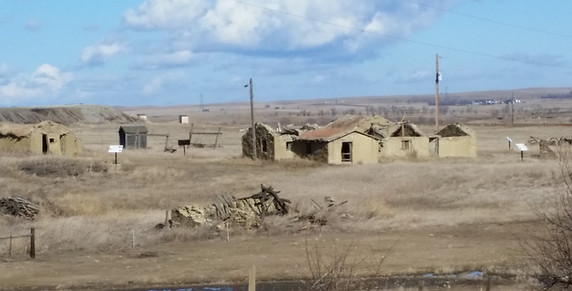
The Hutmacher Farm, located near Manning, North Dakota, was the focus of two service-learning field courses that introduced me to the practical application of historic preservation. Listed on the National Register of Historic Places in 1979, the farmstead consists of five contributing buildings, one contributing structure, and three contributing sites that collectively represent the agricultural heritage of German-Russian settlers on the northern Great Plains. During my first field course, I participated in hands-on preservation activities and learned fundamental preservation techniques. Returning as a graduate student, I led a small team of students and volunteers through various stages of the preservation process. These experiences provided valuable training in preservation methods, project leadership, and stewardship while reinforcing the importance of preserving historic agricultural landscapes.
Replacing the ridge beam over the kitchen.


Tool designed to jack up the earth roof and replace broken rafters.
Completed roof on the main house..for the moment.


A total collapse. This is what happens when the spring snow slowly melts on an earth roof and there is nobody there to remove the snow.
Today, the Hutmacher Farm presents a complex preservation challenge that illustrates the difficulties of protecting historic resources within a changing landscape. Oil development has introduced a retention ponds to the north of the property, while a once lightly traveled gravel road has been paved and now carries frequent semi-truck traffic. The farmstead's close proximity to the roadway has exposed its historic buildings to vibrations and environmental stresses they were never designed to withstand. These preservation concerns are explored in greater detail in the final chapter of my master's thesis. Although the site's future remains uncertain, the Hutmacher Farm continues to demonstrate the importance of preserving the agricultural heritage and cultural landscapes of the northern Great Plains.